
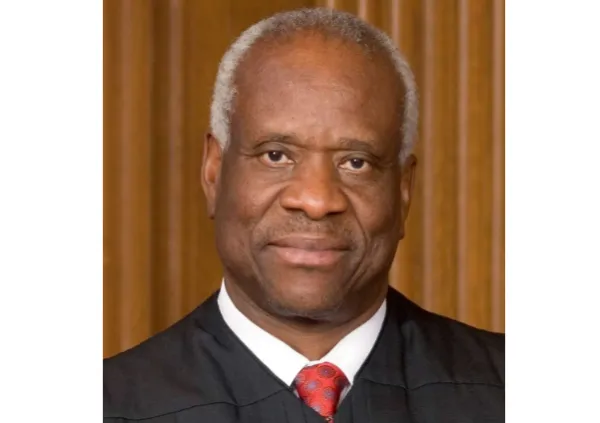
Justice Clarence Thomas’s dissenting and concurring opinions on matters of immigration/birthright citizenship, voting rights, and transgender athletes have once again landed the enigma at the center of controversy. The thinking is and has always been that as a member of an historically marginalized group perhaps Thomas would be empathetic toward similarly situated minorities and move accordingly. Makes sense, yet for the past thirty-five years that hasn’t been the case. Many have maintained that Thomas has done quite the opposite.
Last month the incredibly talented and Harvard educated journalist Joy-Ann Reid expressed her disappointment in Thomas arguing that Thomas is where he is today because of Black peoples’ support. She was referring to his ascension to the United States Supreme Court. Reid claims that public opinion polls in 1991 revealed that Blacks overwhelming supported Thomas’s appointment to the bench. It is true that one poll (ABC News/Washington Post Poll) had Thomas’s support among African Americans at 70 percent. Reid went a step further claiming that this and similar poll results prompted wavering Democrats (meaning Democrats that were on the fence about Thomas’s appointment) on the Senate Judiciary Committee and in the U.S. senate to throw their support behind Thomas for fear of upsetting their Black voting constituency. Not so fast. What Reid conveniently omitted is that Black support for Thomas’s appointment to the bench fluctuated and was at one time as low as 23 or 24 percent.
It should also be noted that only one of the eight Democrats (Senator Dennis DeConcini of Arizona) on the Senate Judiciary Committee voted in favor of Thomas. Senators Joe Biden (Delaware), Edward Kennedy (Massachusetts), Howard Metzenbaum (Ohio), Patrick Leahy (Vermont), Howell Heflin (Alabama), Paul Simon (Illinois), and Herbert Kohl (Wisconsin) all opposed Thomas’s appointment. Republican Senators Strom Thurmond (South Carolina), Orrin Hatch (Utah), Chuck Gressley (Iowa), Arlen Specter (Pennsylvania), Alan Simpson (Wyoming), and John Danforth (Missouri) however were lockstep in their support of Thomas. The result: the vote of the Senate Judiciary Committee on the motion to report favorably failed with a deadlocked outcome of 7 nay votes, 7 yea votes. A second round of deliberations was held under the auspices of a vote of the Senate Judiciary Committee on a motion to report without recommendation that produced 13 votes in favor and 1 against. Democrat Edward Kennedy stood firm in his opposition. The nomination was sent to the full Senate “without recommendation.”
In the end eleven Democrats joined 41 Republicans in support of Thomas resulting in a vote of 52-48 sealing his confirmation. But again, the idea that the Democratic senators were influenced by Black voters’ support of Thomas is not based in fact. The not-so-subtle inference is that Black voters in those eleven states called their senators’ offices and insisted they support Thomas or else risk losing their support in the next election. Yet the logic doesn’t hold. If that were the case, why did six of the seven Democratic senators initially vote against Thomas’s appointment as members of the Senate Judiciary Committee? What’s more, the eleven Democratic senators in question were David Boren of Oklahoma, John Breaux of Louisiana, Dennis DeConcini of Arizona, Alan Dixon of Illinois, James Exon of Nebraska, Wyche Fowler of Georgia, Ernest Hollings of South Carolina, J. Bennett Johnston of Louisiana, Sam Nunn of Georgia, Chuck Robb of Virginia and Richard Shelby of Alabama.
Placing Reid’s thesis under closer scrutiny we uncover some interesting findings. Keep in mind that Thomas was confirmed in October 1991. Boren was reelected in 1990, thus had no reason to fear Black voter defection/abandonment. Moreover, Oklahoma’s Black electorate was too small to sway the outcome of a statewide election. John Breaux of Louisiana was reelected in 1992 with more than 70 percent of the vote while his closest competitor netted less than 10 percent of the vote. Had Blacks withheld their vote, it would have mattered none to Breaux in any way, shape or form. As for Dennis DeConcini, like Oklahoma, the size of Arizona’s Black electorate was too small to determine or influence the outcome of a statewide election. Moreover, he won reelection to his seat in 1988 with 57 percent of the total vote. He retired in 1995 after a lengthy political career.
Exon of Nebraska won reelection in 1990 garnering 54 percent to 43 percent for his opponent. Like, Oklahoma and Arizona the percentage of the Black electorate was too small in Nebraska to have the kind of impact on a statewide election suggested by Reid. J. Bennett Johnston was reelected in 1990 besting the former KKK leader David Duke, by a margin of 54 percent to 41 percent. Were Blacks going to rally around a Duke candidacy? No, but there are always a few outliers that defy explanation. Those outliers were the 2-4 percent of the Black electorate that supported the former KKK grand wizard. In Georgia, Wyche Fowler received more votes than his opponent, yet he lost his reelection bid to Republican Paul Coverdell in 1992 due to a quirky Georgia state rule. Fowler did not achieve a simple majority. Under Georgia law, this required a runoff. Coverdell eked out a victory in the November runoff, despite receiving just 8-10 percent of the Black vote, significantly lower than the 33 percent garnered by another Republican Senator Mack Mattingly in 1980 making him the first Republican senator in the state in more than 100 years. Mattingly’s showing surprised many, yet the explanation is simple. During the campaign Atlanta Mayor Maynard Jackson told Black voters that a vote for former segregationist and Democrat “Herman Talmadge would be the moral equivalent of spitting on the grave of Dr. Martin Luther King, Jr.” Black voters got the message.
In South Carolina, Ernest “Fritz” Hollins was a stalwart in South Carolina politics dating back to the 1960s. He won between 85-90 percent of the Black vote in 1986 and six years later in 1992 he won reelection against Republican Tommy Hartnett by a 50.07 percent to 46.95 percent margin while garnering more than 90 percentage of the Black vote. Was Hartnett a viable option for Black voters? No. There is no modern-day history of Black South Carolinians voting for white statewide Republican candidates. Georgia’s Sam Nunn ran unopposed in 1990, so that’s that. Richard Shelby was reelected by a landslide in Alabama in 1992, besting his opponent by a margin of 31.7 percent of the vote. Virginia’s Charles Robb was elected to the senate in 1988 with more than 70 percent of the vote. The percentage of the Black vote garnered by Maurice Dawkins, Robb’s African American Republican opponent, was a meager 6 percent. Finally, incumbent Alan Dixon of Illinois received just 15-20 percent of the Black vote in the primary because his opponent was a very capable Black woman who had previously served as the Cook Couty Recorder of Deeds and before that as a member of the Illinois House of Representatives for ten years. Carol Moseley Braun took home 80-85 percent of the Black vote, thus becoming the first Black women elected to the United States Senate. Black voters were not going to miss out on this history making opportunity. Furthermore, many Blacks and women in Illinois believed that Anita Hill was treated poorly by the Senate Judiciary Committee during the investigation of the sexual harassment allegations Hill made against Thomas when she worked for him at the department of education and the Equal Employment Opportunity Commission. Voters expressed their displeasure at the ballot box.
None of the scenarios above support Reid’s argument that Black peoples’ support of Thomas’s appointment by way of pressuring the so-called wavering democratic members of the senate judiciary committee and the full senate explain the appointment of Thomas to the U.S. Supreme Court. To argue differently is to engage in revisionist history. Blacks were not responsible for Thomas’s appointment to the highest tribunal in the land. There were plenty of Black folks who opposed Thomas’s appointment, thus the one poll where 70 percent of Blacks reportedly supported Thomas’s appointment was likely an inflated portrayal of the sentiments of African Americans, generally. Given Thomas’s opposition to Affirmative Action it is unlikely that Thomas’s support within the African American community remained steady at 70 percent, if indeed it was ever that high to begin with. Detractors of Thomas within the African American community were in no short supply. The NAACP and the Congressional Black Caucus were vehemently opposed to Thomas’s appointment as was Operation Push. Thurgood Marshall was not fond of the nomination. Outside the African American community the AFL-CIO also opposed the pick. The National Organization for Women opposed Thomas as well as Alliance for Justice. The Urban League and the ACLU remained neutral. L. Douglas Wilder of Virginia the nation’s first elected and only Black governor at the time neither endorsed nor opposed Thomas’s nomination. The Southern Christian Leadership Conference and the Congress of Racial Equality were the only major civil rights groups to endorse Thomas.
It should be noted there was a large segment of the Black populace that had no idea who Clarence Thomas was before he was nominated by President George H. W. Bush and only supported him because he is Black. These same Black folks would have gone along with just about anyone who was Black. They were simply wanting to replace Thurgood Marshall with another Black justice. Replacing Marshall with any nonblack person no matter how impressive their credentials would have been untenable in the minds of many African Americans. But the idea that black voters swayed the democratic senators on the senate judiciary committee as well as those in the full senate to vote in support of Thomas is preposterous and a feeble attempt at revisionist history.
Judson L. Jeffries, PhD, MPH, is Professor of African American and African Studies at The Ohio State University.